 Skip-the-line available
 The History and Legend of the Galata Tower
From the Genoese watchtower of 1348 to fire lookout, prison, and museum — the story of Istanbul's most recognisable tower and its famous flight.
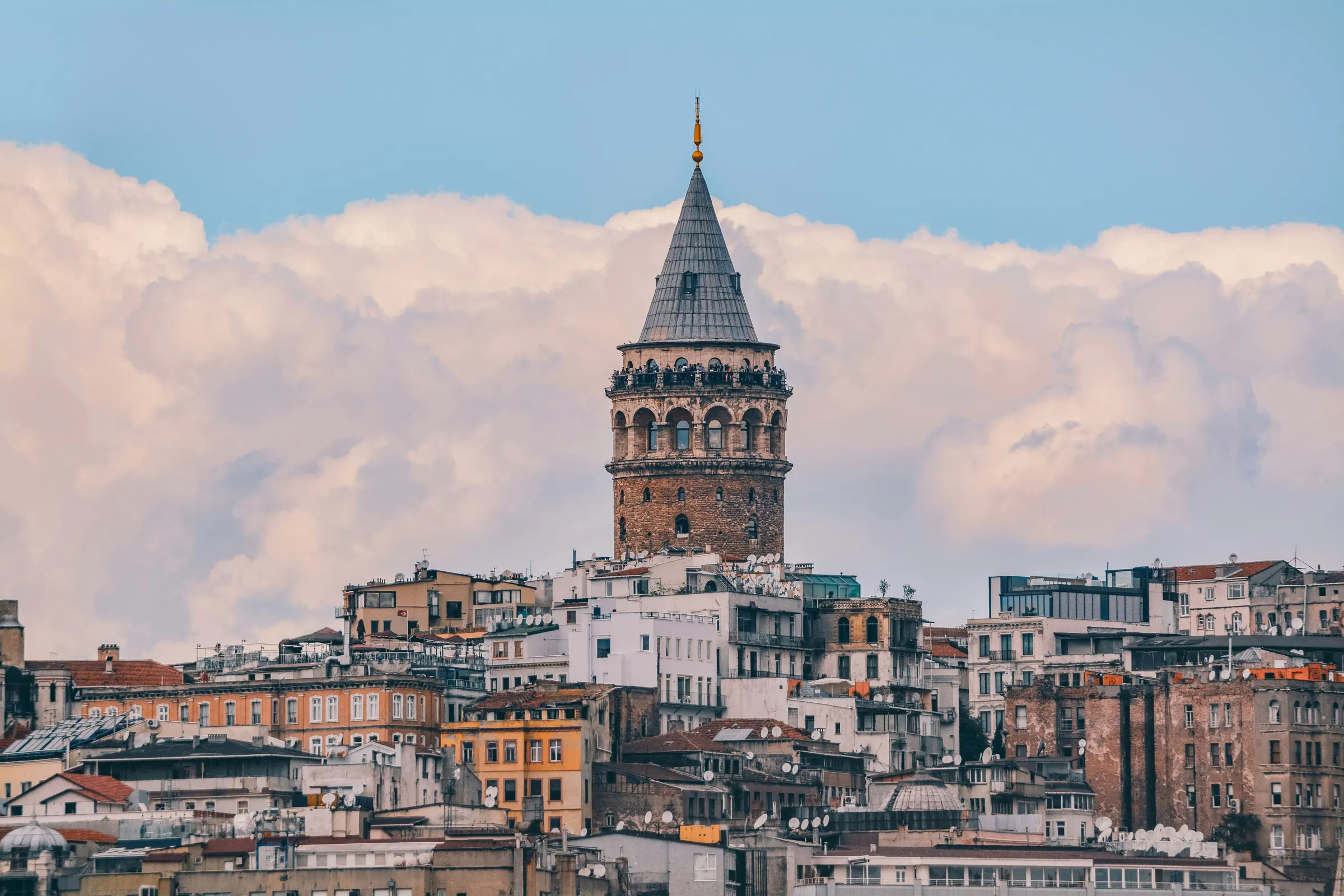
The Galata Tower was built in 1348 by the Genoese as the high point of the walls around their fortified trading colony of Galata, on the northern shore of the Golden Horn. Originally called Christea Turris, the Tower of Christ, the stone tower rises about 62.59 metres and has watched over Istanbul through six centuries of change. After the Ottoman conquest of 1453 it served as a prison and, from the eighteenth century, as a fire-lookout over the timber-built city. It is also tied to the celebrated legend of Hezârfen Ahmed Çelebi, said to have flown from its roof around 1638. This guide traces the tower's history, its uses, its famous legend, and its life today as a museum.
Who built the Galata Tower and when?
The Galata Tower was built in 1348 by the Genoese, the merchant republic that held a fortified trading colony called Galata on the northern shore of the Golden Horn, across the water from Byzantine Constantinople. The tower crowned the defensive walls of that colony and was originally named Christea Turris — the Tower of Christ. Built of stone in a Romanesque style, it rose as the tallest structure in the city, a symbol of Genoese wealth and independence within the Byzantine capital. Our concierge note for visitors is that the tower you climb today is essentially this medieval watchtower, later altered but still fundamentally the fourteenth-century structure. At about 62.59 metres tall, with walls some 3.75 metres thick at the base, it was engineered to dominate the skyline of Galata and to guard the approaches to the Genoese quarter below.
The Genoese colony of Galata was a self-governing enclave with its own walls, granted trading privileges by the Byzantine emperors, and the tower was its keystone — a watchtower that could survey both the Golden Horn and the land approaches to the quarter. Its commanding height let the Genoese monitor shipping in the harbour and signal across the water. Our concierge note is that this defensive origin explains the tower's design: a massive, cylindrical stone shaft with thick walls and a narrow interior, built for strength rather than comfort. The structure measures roughly 16.45 metres across on the outside and only about 8.95 metres inside, the difference taken up by walls thick enough to withstand a siege. Standing on the high ground of Galata, the 1348 tower remains the most complete surviving element of the Genoese fortifications in Istanbul.
How was the Galata Tower used after the Ottoman conquest?
After the Ottoman conquest of Constantinople in 1453, the Galata Tower passed into Ottoman hands and took on a series of new roles over the following centuries. At various times it served as a prison, and from 1717 it was used as a fire-lookout tower, its height letting watchmen spot the blazes that regularly swept through the largely timber-built city and raise the alarm. This practical, civic role kept the medieval tower in continuous use long after the Genoese colony itself had faded into the Ottoman city. Our concierge note is that these changing functions — defensive watchtower, prison, fire-lookout — trace the tower's shift from a symbol of Genoese power to a working part of Ottoman Istanbul. The stone structure, about 62.59 metres tall, remained the tallest lookout in the district, ideally placed above the rooftops of Galata to watch for fire.
The Galata Tower's use as a fire-lookout was more than symbolic: from its high vantage above the wooden houses of the city, watchmen could see fires start and signal their location, a vital service in a metropolis repeatedly ravaged by flame. Over the centuries the tower was damaged and repaired more than once, and its upper section and roof were rebuilt at various times, giving it the conical cap seen today. Our concierge note is that the tower's silhouette is the product of this long life of adaptation rather than a single medieval design. Its nineteenth-century conical roof was reconstructed during a major twentieth-century renovation, and the wooden interior was later replaced with concrete when the tower opened to the public. Through all of it, the 1348 stone shaft on the Galata hill endured as Istanbul's most recognisable tower.
What is the legend of Hezârfen Ahmed Çelebi's flight?
The most famous legend attached to the Galata Tower is that of Hezârfen Ahmed Çelebi, who is said to have flown from the top of the tower across the Bosphorus around 1638 using artificial wings. According to the seventeenth-century account, he glided from the tower's roof and landed on the Asian shore at Üsküdar, an early tale of human flight. Historians treat the story as of doubtful authenticity, but it has become inseparable from the tower's identity and is retold to almost every visitor. Our concierge note is to enjoy the legend for what it is — a celebrated piece of Istanbul folklore rather than documented fact. Standing on the tower's observation deck at just over fifty metres, with the Bosphorus opening toward the Asian side, it is easy to see why the story of a flight from this exact spot has endured for centuries.
The tale of Hezârfen's flight comes down to us chiefly through the writings of the Ottoman traveller Evliya Çelebi, whose seventeenth-century account describes the leap from the Galata Tower across the water to Üsküdar. Whether or not any such flight took place, the legend captures the tower's role in the imagination of Istanbul as a place of daring and vantage. Our concierge note is that the story is best treated as folklore: vivid, memorable, and unverifiable, but part of what makes the tower more than a watchtower. The name Hezârfen means roughly 'thousand-science' or polymath, a fitting epithet for a legendary inventor. From the panoramic gallery of the roughly 62.59-metre tower, looking across the Bosphorus toward the Asian shore at Üsküdar, the enduring appeal of the tale is easy to understand. Whether history or legend, the story keeps the 1348 tower alive in the imagination of every visitor who climbs it.
How did the Galata Tower become the museum it is today?
The Galata Tower became a public attraction in the twentieth century: between 1965 and 1967 its worn wooden interior was replaced with concrete, its conical roof reconstructed, and the tower opened to visitors with a lift installed to carry them toward the top. This transformed the medieval watchtower into an accessible viewpoint over Istanbul while preserving its 1348 stone shell. Our concierge note is that this renovation is why visitors can ride most of the way up rather than climb all eleven storeys on foot. The tower stands about 62.59 metres tall, and the observation deck near its summit, at roughly 51.65 metres, was opened as the panoramic gallery that draws visitors today. From that ring, the view spans the Golden Horn, the Bosphorus, and the old city, a reward that the tower's builders could hardly have imagined for their fortification.
More recently the Galata Tower underwent a major restoration and reopened as a museum in 2020, with further structural work carried out afterward, and it now operates under a limited hourly visitor capacity to protect the historic structure. The museum displays on the floors below the viewing gallery tell the tower's long story, from Genoese watchtower to Ottoman fire-lookout to modern icon. Our concierge note is that the hourly cap is why timing your visit matters, especially around the busy sunset hour. The tower is administered under Turkey's Ministry of Culture and Tourism as a national heritage site. At about 62.59 metres, with its distinctive conical roof rising over the Galata quarter of Beyoğlu, the 1348 tower remains the defining landmark of the northern shore of the Golden Horn. Its long life — from Genoese watchtower to modern museum — is part of what makes the climb to its gallery so rewarding today.
Why is the Galata Tower so important to Istanbul's skyline?
The Galata Tower is one of Istanbul's most recognisable landmarks because it has stood on the high ground of the Galata quarter, dominating the northern skyline of the Golden Horn, since 1348. Where the old city's silhouette is defined by domes and minarets, the Galata shore is defined by this single cylindrical stone tower with its conical roof, visible from the water, the bridges, and the historic peninsula opposite. Our concierge note is that the tower's prominence is both historic and geographic: it was built as the tallest structure in the city and still commands its hill. At about 62.59 metres tall, it functions as a natural orientation point across central Istanbul, the marker that tells you where the Galata and Beyoğlu quarters rise above the harbour. Few single structures are as tied to a city's identity as this Genoese tower is to Istanbul.
The tower's importance also lies in what survives: it is the most complete remaining element of the medieval Genoese fortifications that once ringed the trading colony of Galata. Where the colony's walls have largely vanished into the modern city, the tower endures as a tangible link to the fourteenth-century merchant republic that built it. Our concierge note is that climbing the tower is, in effect, standing on the last great monument of Genoese Istanbul. The stone shaft, roughly 16.45 metres across and with walls some 3.75 metres thick, was engineered to last, and it has — through conquest, fire, and centuries of reuse. Today, rising over the Galata hill on the northern shore of the Golden Horn, the 1348 tower remains both a historic survivor and the defining feature of this side of the city.
Frequently asked
Who built the Galata Tower and when?
The Galata Tower was built in 1348 by the Genoese, as the high point of the walls around their fortified trading colony of Galata on the northern shore of the Golden Horn. It was originally named Christea Turris, the Tower of Christ.
What was the Galata Tower originally used for?
It was built as a watchtower crowning the defensive walls of the Genoese colony of Galata, letting the Genoese survey shipping in the Golden Horn and the land approaches to their quarter. At about 62.59 metres, it was the tallest structure in the medieval city.
How was the Galata Tower used after 1453?
After the Ottoman conquest of 1453 the tower served at various times as a prison, and from 1717 as a fire-lookout, its height letting watchmen spot fires in the largely timber-built city and raise the alarm across the district.
What is the legend of Hezârfen Ahmed Çelebi?
Legend holds that Hezârfen Ahmed Çelebi flew from the top of the Galata Tower across the Bosphorus to the Asian shore at Üsküdar around 1638 using artificial wings. Historians regard the story as of doubtful authenticity, but it remains central to the tower's fame.
How tall is the Galata Tower?
The Galata Tower rises about 62.59 metres in total, with its observation deck at roughly 51.65 metres. It is a cylindrical stone tower about 16.45 metres across on the outside, with walls some 3.75 metres thick at the base, spanning eleven floors.
When did the Galata Tower open to the public?
The tower opened to visitors after a renovation between 1965 and 1967, when its wooden interior was replaced with concrete and a lift was installed. It later underwent a major restoration and reopened as a museum in 2020.
Who manages the Galata Tower today?
The Galata Tower is administered as a national heritage site under Turkey's Ministry of Culture and Tourism. It operates as a museum with a limited hourly visitor capacity to protect the historic 1348 structure.
Why is the Galata Tower famous?
It is Istanbul's most recognisable tower — a Genoese watchtower of 1348 that dominates the Galata skyline, the most complete surviving piece of the medieval Genoese fortifications, and the setting of the celebrated Hezârfen flight legend.
Is the Galata Tower medieval?
Yes. The core of the tower is the stone watchtower built by the Genoese in 1348, later repaired and altered — the conical roof and interior were rebuilt in modern times — but the structure you climb today is essentially the fourteenth-century tower.